Earthquakes: A Way of Life for Belize
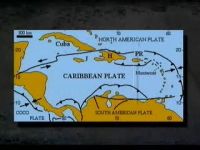
And the reason those coastal communities got hardest hit is because
they are directly in line with what’s called the Motagua fault, the boundary
of the North American and Caribbean tectonic plates. IT may sound technical,
but you need to know because that plate boundary cuts right between Honduras
and Belize and it’s friction along that fault that caused Thursday’s
quake. Cho explained.
Andre Cho, Geologist
“Belize lies on the North American Tectonic Plate, Central America
and the Caribbean Plate and there is a transformed plate boundary down there
that is sliding, the two plates are sliding cross each other and so it cause
faults in the rocks and as the rocks are sliding each other, friction holds
them together and so energy is being built up in there and when the energy overcomes
the friction it breaks the rocks and causes the energy to be released in the
form of an earthquake. So once that energy has been released the major earthquake
has passed and then like I said you will normally experience some tremors for
some time after. Another earthquake won’t occur again until that same 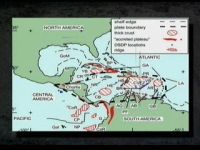 scenario where it is built up again and then violently released.”
Jules Vasquez,
Are earthquakes a reality that we will now have to live with?
Andre Cho,
“Yes it has always been so. We just haven’t experienced one
like this because like I said we are right near to a plate boundary, the transplant
plate boundary between the North American and Caribbean plate. Historically
we just haven’t experienced large earthquakes like this one or larger
but we have always been in a earthquake prone zone and so an earthquake is a
real hazard that we live with and we need to be prepared for. Because we are
near to this transplant plant boundary, and like I said earthquakes are a reality
that we have always lived with.
It is just like I said historically we haven’t experienced any major
earthquakes or any damages from earthquakes. But like I said, this recent earthquake
is a wake up call for us. We need to know and realize and understand that we
do live near a plate boundary and we need to be aware of earthquakes and be
prepared for them.”
While stressing that he is not a seismologist that studies earthquakes
– indeed, there’s no one with that specialty in Belize – and
a geologist is the next best thing. The last time Belizeans recall feeling such
a powerful quake was in 1976 when that same fault line, called the Motagua fault
caused a 7.5 magnitude quake. It struck inside Guatemala near Puerto Barrios.
It struck at 3:00 in the morning and killed over twenty thousand. So far in
this quake, Honduras is reporting six dead, and Belize one elderly woman from
Dangriga who expired in the fright.
In Monkey River NEMO reports that 31 structures were damaged, with
8 houses badly damaged and another two extensively damaged. The footing for
the water tower was also damaged. In Independence, the water supply has been
restored and Seine Byte reports minimal damage to the school building. Columns
for the water tower in that village are also a concern. The full report on Placencia
hasn’t been sent out yet but the water reservoir was damaged and a number
of homes were affected. Again, NEMO has not completed its report on that village.


 AmbergrisCaye.com